Epiphany Cathedral is one of the most distinctive religious landmarks in Irkutsk and one of the most important surviving monuments from the city’s early history. Standing close to the Angara River, Kirov Square and the Church of the Savior, the cathedral forms part of the architectural ensemble marking the birthplace of Irkutsk.
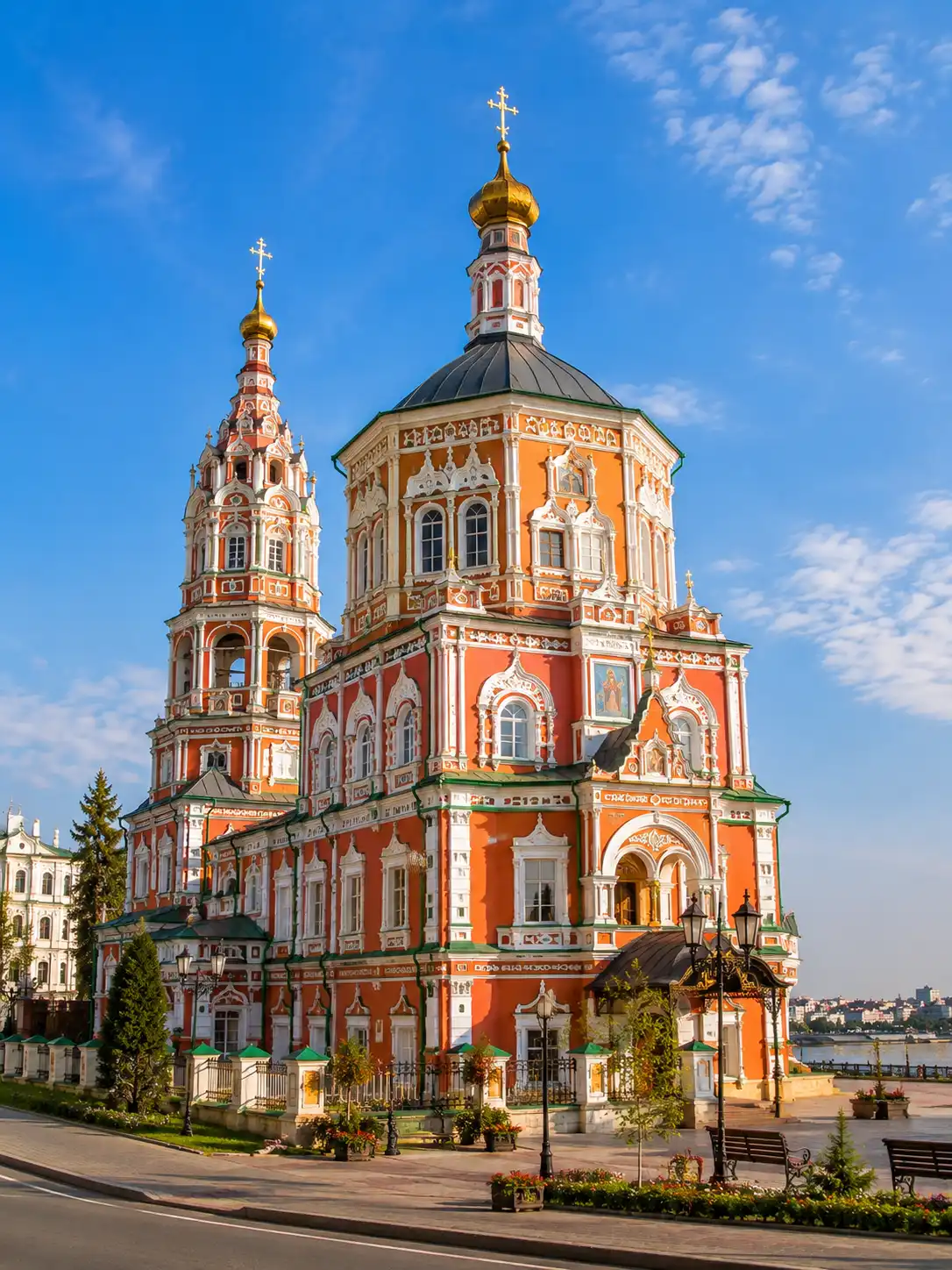
Known in Russian as Собор Богоявления or Богоявленский собор, the cathedral attracts attention immediately through its colourful façades, decorative brickwork, multiple roof forms and combination of white, orange, green and gold architectural elements. Its appearance differs considerably from the restrained classical churches found in many other Russian cities.
The present stone cathedral was constructed during the first half of the eighteenth century after an earlier wooden church was destroyed by fire. Construction began during the 1720s, and the completed cathedral opened in 1746. It is considered the second-oldest surviving stone building in Irkutsk after the nearby Church of the Savior.
The building reflects the architectural development of eastern Siberia at a time when Irkutsk was becoming a major administrative, religious and commercial centre. Old Russian decorative traditions, Baroque forms and later Classical additions were gradually combined into the cathedral’s present appearance.
Epiphany Cathedral also survived a dramatic period of closure and secular use during the Soviet era. Religious services ended, and the complex was adapted for non-religious purposes, including use connected with a bakery. Restoration work later preserved the building as an architectural monument, and it eventually returned to active Orthodox worship.
For travellers following Wander Russia through Irkutsk, Epiphany Cathedral is an essential part of the historical centre. This guide explains the cathedral’s history, architecture, interior, Soviet transformation, religious meaning, visitor etiquette, photography opportunities and the best way to combine it with nearby attractions.
Where Is Epiphany Cathedral?
Epiphany Cathedral stands in central Irkutsk near the lower embankment of the Angara River.
The commonly listed address is 1A Sukhe-Batora Street. The cathedral lies immediately east of Kirov Square and only a short walk from the Church of the Savior, the Eternal Flame memorial and the waterfront.
This concentration of monuments makes the area one of the most important historical zones in Irkutsk. Visitors can explore several centuries of architecture without needing public transport between individual attractions.
The cathedral originally stood just outside the eastern wall of the wooden Irkutsk fortress. Its position therefore preserves the relationship between the early fortified settlement, the Angara River and the later expansion of the city.
The location remains especially attractive today because the cathedral can be viewed against open sky and river scenery rather than being enclosed completely by modern buildings.
Why Epiphany Cathedral Is One of Irkutsk’s Must-See Places
Epiphany Cathedral is important for several reasons.
It is one of the oldest surviving stone buildings in the city and a major example of the architectural transition from early Russian church traditions to the more decorative forms associated with Siberian Baroque.
It also stands close to the location where Irkutsk developed from a seventeenth-century wooden fort into one of the most important cities of eastern Siberia.
The building’s history reflects nearly every major stage of Irkutsk’s development:
- The early wooden settlement
- The destructive fires of the eighteenth century
- The growth of merchant wealth
- The rise of Siberian stone architecture
- Imperial religious life
- Soviet anti-religious policy
- Architectural restoration
- The modern revival of Orthodox worship
The cathedral is therefore much more than a colourful church beside the river. It is a physical record of the city’s survival and transformation.
The First Wooden Church
The history of the cathedral began in 1693, when a wooden church was constructed near the eastern side of the Irkutsk fortress.
Historical accounts differ slightly regarding the earliest dedication, but the first building is often associated with the Church of Saints Peter and Paul and later with the Epiphany Cathedral tradition. It stood outside the Epiphany Tower of the wooden kremlin.
Wood was the main construction material in early Irkutsk. It was widely available, relatively easy to work with and suitable for rapid settlement construction.
However, wooden towns faced a constant danger from fire.
In 1716, a major fire destroyed the first cathedral. The loss was part of a wider pattern in early Siberian cities, where churches, houses and commercial buildings could disappear within hours.
The decision to replace the church with a stone structure reflected both practical concerns and the growing prosperity of Irkutsk.
Construction of the Stone Cathedral
Construction of the present stone cathedral began during the early 1720s.
Sources give slightly different starting dates, including 1718 and 1722, but agree that the project followed soon after the destruction of the wooden church and was completed by the middle of the eighteenth century. The cathedral officially opened in September 1746.
The project was financed through donations from residents of Irkutsk.
This local support is significant. The cathedral was not simply imposed by distant imperial authorities. It represented the ambition of a growing Siberian community seeking a permanent and impressive religious centre.
Stone construction in eastern Siberia was difficult and expensive. Skilled craftsmen, bricks, lime, metalwork and decorative materials had to be organised across great distances.
The completion of the cathedral therefore demonstrated Irkutsk’s increasing wealth, stability and regional importance.
One of Irkutsk’s Oldest Stone Buildings
Epiphany Cathedral is generally identified as the second-oldest surviving stone building in Irkutsk.
The nearby Church of the Savior is older and has an even closer connection with the original fortress.
Together, the two churches form one of the most historically important architectural groups in eastern Siberia.
Most of early Irkutsk was constructed from timber, and repeated fires destroyed many older structures. The survival of these stone churches therefore provides rare physical evidence of the city during the first half of the eighteenth century.
Visitors should ideally see both buildings during the same walk. Their proximity makes it possible to compare two different expressions of early Siberian Orthodox architecture.
Siberian Baroque
Epiphany Cathedral is often described as a major example of Siberian Baroque.
This regional architectural tradition developed during the eighteenth century as builders adapted Russian and Ukrainian Baroque ideas to Siberian conditions, local craftsmanship and eastern decorative influences.
Siberian Baroque buildings are known for complex silhouettes, richly ornamented façades, multiple roof forms and a strong emphasis on decorative surface detail.
Irkutsk became one of the principal centres of the style. The city preserves several important churches demonstrating how regional builders created architecture that was recognisably Russian Orthodox yet distinct from the major churches of Moscow and Saint Petersburg.
Epiphany Cathedral is not a perfectly uniform Baroque structure. Later additions introduced Classical elements, especially around the bell towers. The result is a layered building reflecting several construction phases rather than one single architectural plan.
The Colourful Exterior
The cathedral’s exterior is one of the most visually memorable in Irkutsk.
White decorative details stand out against warm orange or red wall surfaces. Green roofs, small golden domes and repeated ornamental bands create a rich composition without making the building feel excessively large.
The façades contain:
- Decorative window frames
- Repeated arches
- Pilasters and mouldings
- Ornamental brick patterns
- Religious images
- Curved gables
- Small towers and domes
- Contrasting painted surfaces
The visual effect is often compared with an elaborately decorated ceremonial object rather than a simple rectangular church.
The cathedral’s colour scheme is especially striking in winter. Snow around the building intensifies the contrast between white decoration, warm walls and gold roof elements.
Old Russian and Northern Architectural Influences
The decoration also contains influences associated with older Russian architectural traditions and the churches of northern Russia.
Historical descriptions note the combination of Old Russian motifs with Baroque design. This mixture gives the cathedral a more regional and handcrafted appearance than the formal symmetry of later neoclassical churches.
The building does not present one calm, unified façade. Instead, it invites visitors to walk around it and discover changing shapes and details from different directions.
From one angle, the bell tower dominates. From another, the central church volume and smaller domes become more visible. Closer examination reveals painted images and decorative masonry that may be missed from the main street.
The Bell Towers
The cathedral complex developed more than one bell-tower element over time.
The first bell tower formed part of the eighteenth-century construction. In the early nineteenth century, an additional bell tower was built in a more Classical style. Sources commonly date this addition to around 1812 or 1815.
This later construction reflects changing architectural taste.
By the nineteenth century, Russian Classicism had become more influential, favouring cleaner lines and greater formal order than the decorative Baroque tradition.
The bell towers therefore make the cathedral particularly interesting for architectural comparison. The building preserves evidence of changing styles while remaining visually coherent.
A large bell cast during the late eighteenth century also influenced the development of the tower arrangement. The scale of the bell required appropriate structural support and helped increase the ceremonial importance of the cathedral.
The Cathedral Interior
The interior is richly decorated and visually very different from the exterior.
Wall paintings, icons, gilded details and religious imagery cover much of the available surface. Visitors may encounter images of saints, biblical scenes, angels and major events from Orthodox Christian history.
The modern painted decoration includes a large iconographic programme presenting themes from Russian religious history.
The result is immersive. The interior is not organised like a quiet Western European church with broad areas of undecorated stone. Colour, symbolism and sacred images surround the visitor from several directions.
This visual density reflects the Orthodox understanding of the church as a representation of the spiritual world.
Visitors should remember that the interior remains an active religious space. It is not simply an art gallery.
The Meaning of the Epiphany
The cathedral is dedicated to the Epiphany, one of the major feasts of the Orthodox Christian calendar.
In the Eastern Christian tradition, the feast is closely associated with the baptism of Christ in the River Jordan and the revelation of the Holy Trinity.
The Russian term Богоявление means the manifestation or appearance of God.
The feast is celebrated in January according to the Orthodox calendar. Religious services may include the blessing of water, processions and large congregations.
Visiting during the feast can provide a deeper understanding of the cathedral’s living religious role, but access may be crowded and photography should remain especially discreet.
The Cathedral as the Main Church of Irkutsk
For a long period, Epiphany Cathedral served as one of the most important churches in Irkutsk.
It became closely connected with major public events, religious festivals and moments of crisis.
Before the construction of later cathedrals, it functioned as a central religious institution for the city and surrounding region.
Its position near administrative and commercial areas strengthened this role. Officials, merchants, travellers and ordinary residents would have encountered the cathedral as part of everyday city life.
The bells, processions and services helped organise the rhythm of the historical centre.
Earthquakes, Fires and Repairs
Irkutsk lies within a region affected by seismic activity, and the cathedral has experienced structural damage from earthquakes as well as the effects of Siberian weather.
Repeated repairs and additions changed the building over time.
This long process helps explain why the cathedral contains architectural elements from different periods. It was not built once and then preserved without alteration. Like many historic religious buildings, it was adapted repeatedly according to structural needs, new artistic preferences and changing liturgical requirements.
The fact that it survived at all is remarkable considering the fires, earthquakes, political upheaval and periods of inappropriate use it endured.
Closure During the Soviet Period
Religious services ended during the Soviet period as part of broader state campaigns against organised religion.
The cathedral was closed during the 1930s and converted to secular purposes. Parts of the complex were reportedly used as a bakery or connected with bread production, while other areas served as accommodation or storage.
This transformation damaged the sacred interior and altered the building’s original function.
However, secular use may also have contributed indirectly to the structure’s survival. Many churches elsewhere were demolished completely. Epiphany Cathedral remained standing because it continued to serve a practical purpose.
The contrast between sacred architecture and industrial use illustrates the dramatic ideological change that affected religious monuments throughout the Soviet Union.
Recognition as an Architectural Monument
By the middle of the twentieth century, the historical and architectural importance of the cathedral received greater recognition.
The building was registered as an architectural monument, and restoration work began during the Soviet era.
Major restoration campaigns took place between the late 1960s and the 1980s. Specialists repaired structural elements, studied historical details and worked to recover the cathedral’s architectural appearance.
This preservation effort belonged to a broader shift in Soviet heritage policy. Although active religion remained restricted, historic churches were increasingly valued as architecture, art and evidence of national history.
The cathedral therefore survived through an unusual combination of secular reuse and official monument protection.
Return to Orthodox Worship
After the end of the Soviet period, Epiphany Cathedral returned to active religious life.
Services resumed, the interior was renewed and the building again became one of the central Orthodox landmarks of Irkutsk.
Today, visitors may encounter liturgies, baptisms, prayer services and private worship.
The return to religious use changed the character of the monument. It is now both a protected cultural site and a functioning sacred space.
That dual identity requires respectful behaviour from travellers.
Visitor Etiquette
Appropriate behaviour includes:
- Speaking quietly
- Switching phones to silent mode
- Avoiding food and drinks inside
- Wearing modest clothing
- Removing hats for men when customary
- Covering the head for women when requested or preferred
- Avoiding direct photography of worshippers
- Following all signs concerning interior photography
- Not walking directly in front of the altar during services
- Allowing local believers space for prayer
Visitors do not need to copy Orthodox gestures or religious practices.
Quiet and respectful observation is sufficient.
Photography
The cathedral is one of the most photogenic buildings in Irkutsk.
The strongest exterior compositions often include several architectural levels at once: the warm-coloured walls, white ornament, green roof details, golden domes and open Siberian sky.
Useful subjects include:
- The full cathedral from the river side
- Bell towers against the sky
- Painted exterior details
- Decorative brickwork
- Snow around the building
- The cathedral with the Angara nearby
- Evening illumination
- The contrast with the Church of the Savior
- Interior icons when photography is permitted
- Reflections after rain
Morning and late afternoon usually provide the strongest light.
A standard lens creates more natural proportions, while a moderate wide-angle lens is useful when space is limited.
Best Time to Visit
The cathedral can be visited throughout the year.
Late spring through early autumn provides the most comfortable conditions for walking around the exterior and continuing along the Angara embankment.
Winter is particularly atmospheric. Snow highlights the decorative architecture and creates a strong visual connection with the Siberian setting.
A weekday morning is generally the best time for a quiet visit.
Sundays and religious feast days provide a richer spiritual atmosphere but may bring larger congregations.
Opening conditions can change according to services and religious events, so visitors should avoid treating the church like a museum with a rigid sightseeing timetable.
Combining the Cathedral with Nearby Attractions
A practical historical route includes:
- Kirov Square
- Church of the Savior
- Epiphany Cathedral
- Eternal Flame memorial
- Lower Angara Embankment
- Monument to Alexander III
- Karl Marx Street
- 130 Kvartal
The Church of the Savior and Epiphany Cathedral should ideally be viewed together.
The first recalls the original Irkutsk fortress, while the second demonstrates how the city’s religious and architectural ambitions expanded during the eighteenth century.
The nearby former Polish Catholic church adds another layer to the district and has led to the area sometimes being promoted as a square or ensemble of three churches.
How Much Time Is Needed?
A basic exterior and interior visit takes approximately 30 to 45 minutes.
Travellers interested in architecture, photography and religious art may spend one hour.
Combining the cathedral with the Church of the Savior, Kirov Square and the embankment creates a two- to three-hour walking route.
Accessibility
The cathedral stands in a central, paved area and is easier to reach than many attractions located in Irkutsk’s older residential streets.
Some entrances may have steps or raised thresholds.
Winter snow and ice can reduce accessibility around the building.
Visitors with mobility requirements should look for the most level entrance and ask church staff for assistance when necessary.
Is Epiphany Cathedral Worth Visiting?
Epiphany Cathedral is one of the essential sights of Irkutsk.
Its colourful exterior provides immediate visual appeal, but the deeper value lies in its history.
The building connects the early wooden fortress, eighteenth-century stone construction, merchant patronage, Siberian Baroque, Soviet secularisation, architectural preservation and modern Orthodox revival.
Wander Russia recommends including the cathedral in every first visit to the historical centre.
Frequently Asked Questions
When was Epiphany Cathedral built?
The present stone building was constructed during the first half of the eighteenth century and opened in 1746.
What stood there before the cathedral?
A wooden church built in 1693 stood on the site before being destroyed by fire in 1716.
What architectural style does it represent?
The cathedral combines Siberian Baroque, Old Russian decorative traditions and later Classical elements.
Is it an active church?
Yes. It functions as an active Russian Orthodox cathedral.
What happened during the Soviet period?
The cathedral was closed and adapted for secular uses, including functions connected with a bakery, before restoration began.
Is there an entrance fee?
General entry to active Orthodox churches is normally free, although donations are welcome.
How long should visitors stay?
Allow approximately 30 to 60 minutes.
What is nearby?
Kirov Square, the Church of the Savior, the Eternal Flame and the Angara embankment are all within a short walk.
When is the best time to photograph it?
Morning, late afternoon and snowy winter days provide especially attractive conditions.
Can visitors photograph the interior?
Rules can vary. Visitors should check signs and ask permission before taking photographs.
Conclusion
Epiphany Cathedral is one of the buildings that best explains the historical depth of Irkutsk.
Its story began with a wooden church beside the early fortress. Fire destroyed that first structure, but the growing city replaced it with an ambitious stone cathedral funded by local residents.
The completed building reflected the confidence of eighteenth-century Irkutsk.
Its decorative façades, changing rooflines and bell towers expressed a regional form of Orthodox architecture shaped far from Moscow and Saint Petersburg.
Later generations added Classical elements, repaired earthquake damage and adapted the cathedral to changing religious needs.
The Soviet period brought the most dramatic transformation. Worship ended, the sacred interior was altered and the building became part of a secular industrial system.
Yet the cathedral survived.
Recognition as an architectural monument led to extensive restoration, and the post-Soviet revival returned the building to Orthodox worship.
Today, bells and religious services once again form part of the historical centre.
The cathedral’s setting adds to its meaning. The Angara River flows nearby, the Church of the Savior recalls the first fortress and Kirov Square marks the civic centre that developed around them.
For travellers following Wander Russia through Irkutsk, Epiphany Cathedral is the essential fourth destination after 130 Kvartal, the Angara Embankment and Kirov Square.
It brings architecture, religion and the survival of the city’s earliest heritage together within one remarkable building.
