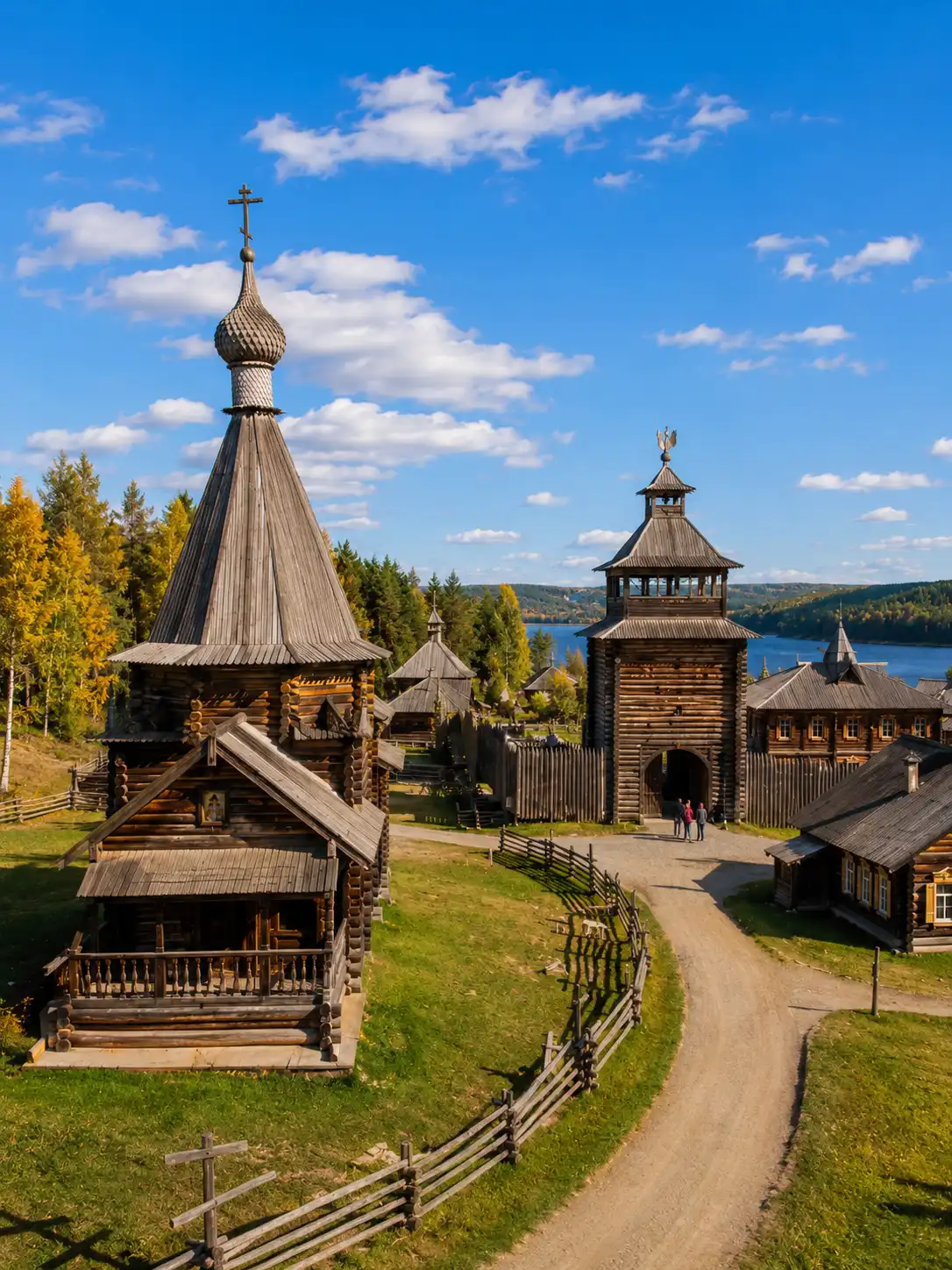
Taltsy Museum of Wooden Architecture and Ethnography is one of the most important cultural attractions in the Irkutsk region and one of the most rewarding excursions between Irkutsk and Lake Baikal. Located in a forested area beside the Angara River, the open-air museum preserves historic wooden houses, churches, farm buildings, defensive towers and traditional structures representing the peoples of the Baikal region.
Known in Russian as Архитектурно-этнографический музей «Тальцы», the museum is situated along the main road connecting Irkutsk with Listvyanka. Its location makes it particularly convenient for travellers planning to visit Lake Baikal, as the museum can be included during the outward or return journey without requiring a major detour.
Taltsy is not organised like a conventional indoor museum. Visitors walk through a broad natural landscape containing reconstructed villages, historical farmsteads, religious buildings and ethnographic complexes. Many of the structures were transferred from settlements threatened by flooding during the construction of hydroelectric facilities along the Angara River.
The museum preserves architecture associated with Russian settlers, Siberian Cossacks, Buryats and Evenks. It also contains structures connected with the historic Ilimsk fortress, including an original seventeenth-century wooden tower and religious buildings rescued from the former settlement before the surrounding territory was submerged.
The result is a cultural landscape rather than a simple collection of individual monuments. Visitors can enter historic homes, examine household interiors, walk through defensive gates, see traditional tools and understand how people adapted architecture to Siberia’s severe climate.
Taltsy is especially attractive because it combines history with nature. Pine and birch forests surround the museum, while views toward the Angara add a strong sense of place. In summer, the grounds are green and active. During autumn, golden foliage transforms the wooden buildings. In winter, deep snow, horse-drawn sleighs and seasonal celebrations create one of the most atmospheric museum experiences in Siberia.
For travellers following Wander Russia through Irkutsk, Taltsy Museum provides the essential tenth destination in the city’s wider sightseeing region. It connects the wooden architecture of Irkutsk with the rural cultures, frontier settlements and Indigenous traditions of the Baikal area.
Where Is Taltsy Museum?
Taltsy Museum is located approximately halfway between Irkutsk and Listvyanka on the road toward Lake Baikal.
The museum stands around 47 kilometres from central Irkutsk and roughly 20 kilometres before Listvyanka, depending on the route and measuring point. The journey usually takes approximately one hour from Irkutsk under normal traffic conditions.
Its position makes Taltsy an ideal stop during a day trip to Lake Baikal.
A common itinerary begins in Irkutsk, continues to Taltsy Museum during the morning and reaches Listvyanka later in the day. The reverse route also works well, particularly for visitors who want to see Lake Baikal first and explore the museum during the afternoon.
The grounds lie close to the Angara River and are surrounded by woodland. The natural setting is an important part of the experience because the historical buildings appear within a landscape similar to the environments in which many originally stood.
Why Taltsy Is One of the Region’s Must-See Attractions
Taltsy Museum is important because it preserves buildings and ways of life that were disappearing through industrial development, urbanisation and changing rural conditions.
Several of its most significant monuments came from settlements affected by the construction of hydroelectric dams. When river valleys were flooded, historic villages, churches and fortifications faced permanent destruction.
Museum specialists documented selected structures, dismantled them carefully and reconstructed them at Taltsy.
This work preserved more than architecture. Historic buildings contain information about construction techniques, family organisation, climate adaptation, religion, agriculture and community life.
Taltsy also presents multiple cultural traditions within the same museum.
Visitors can compare:
- Russian peasant farmsteads
- Siberian Cossack structures
- Buryat dwellings
- Evenki camps
- Orthodox religious buildings
- Defensive towers
- Workshops and mills
- Administrative buildings
- School and community spaces
- Traditional storage structures
This broad approach helps explain that the Baikal region developed through interaction among Indigenous peoples, Russian settlers, traders, officials, missionaries and exiles.
The Foundation of the Museum
Taltsy Museum was established during the second half of the twentieth century as part of an effort to preserve the wooden architectural heritage of the Irkutsk region.
The construction of hydroelectric power stations along the Angara created reservoirs that submerged settlements and altered large sections of the historic river landscape.
Researchers, architects and museum specialists identified significant buildings that could be saved.
The process required detailed documentation. Each log and structural component had to be numbered before dismantling. The buildings were then transported and reconstructed on the museum grounds.
This method is especially suitable for traditional Siberian wooden architecture because log structures can often be taken apart and rebuilt without destroying the entire construction system.
Taltsy gradually expanded into a major open-air museum containing dozens of architectural monuments and thousands of ethnographic objects.
The Angara River Setting
The Angara River is central to the history represented at Taltsy.
It is the only river flowing out of Lake Baikal and has served as a route for migration, transport, fishing and trade.
Settlements developed along its banks because the river provided water, food and communication across otherwise difficult terrain.
The same river also caused the disappearance of several historic sites when dams and reservoirs were constructed.
Taltsy therefore stands in a symbolic relationship with the Angara. The museum preserves buildings rescued from changing river valleys while presenting them beside the same water system that shaped their original communities.
The river views add considerable atmosphere to the museum walk. In winter, snow and ice create a severe northern landscape. In summer, water and forest soften the appearance of the wooden settlements.
The Ilimsk Fortress Complex
The Ilimsk fortress section is one of the most historically significant parts of Taltsy Museum.
Ilimsk was an important Siberian settlement and administrative centre established during Russian expansion eastward. It developed around a wooden ostrog, or fortified settlement, serving military, taxation and transport functions.
The construction of the Ust-Ilimsk hydroelectric project threatened the remains of the historic town.
Selected buildings were rescued and transferred to Taltsy before the original area was flooded.
The preserved complex allows visitors to understand the appearance of a seventeenth-century Siberian fortress more clearly than a written description alone.
The Spasskaya Tower
The Spasskaya Tower is one of Taltsy’s most valuable architectural monuments.
The wooden defensive tower originally belonged to the Ilimsk fortress and dates from the seventeenth century. It is among the oldest surviving examples of Russian wooden defensive architecture in Siberia.
The tower combines military and symbolic functions.
Its elevated structure allowed guards to observe the surrounding territory, control access and respond to threats. The gate passage regulated movement into the fortified settlement.
The name Spasskaya refers to the Savior, reflecting the close relationship between religious symbolism and military protection in early Russian frontier settlements.
Visitors can examine the massive log construction, steep roof and defensive proportions.
The tower gives Taltsy a strong visual identity and helps distinguish it from museums focused only on peasant houses.
The Kazan Church from Ilimsk
Another important structure associated with Ilimsk is the wooden Kazan Church.
The building demonstrates the skill of Siberian carpenters who created religious architecture without the monumental stone construction found in larger cities.
Wooden churches required careful engineering.
Builders had to manage snow loads, moisture, temperature changes and the natural movement of timber. Roofs were designed to shed snow, while log walls provided insulation during severe winters.
The church also reflects the central role of Orthodox Christianity in the organisation of Russian frontier settlements.
Religious buildings served as places of worship, community gathering and identity. Their bells and feast days structured the rhythm of local life.
Russian Peasant Farmsteads
The Russian rural complexes form a major part of the museum.
A traditional Siberian farmstead included much more than one house. It was a self-contained working environment containing residential rooms, barns, storage buildings, animal shelters, workshops, fences and gates.
The organisation of the courtyard reflected the need to survive long winters and maintain supplies.
Common features include:
- Large log houses
- Russian stoves
- Food-storage rooms
- Grain barns
- Livestock shelters
- Enclosed courtyards
- Wells
- Workshops
- Bathhouses
- Decorative gates
Visitors can enter several houses and examine reconstructed interiors.
Furniture, icons, textiles, dishes, tools and household objects reveal how families lived, worked and organised space.
The Russian Stove
The Russian stove was the centre of traditional domestic life.
It provided heat, cooked food and sometimes served as a warm sleeping platform. In Siberia, where winter temperatures could remain extremely low for long periods, the stove was essential for survival.
Its large masonry structure stored heat and released it gradually.
The placement of the stove influenced the organisation of the entire room. Cooking equipment, benches, sleeping spaces and household activities developed around it.
Museum interiors make it easier to understand how one room could serve several functions simultaneously.
The stove demonstrates that traditional architecture was not primitive. It was carefully adapted to climate, fuel availability and family needs.
Merchant and Wealthier Households
Not every family lived under the same conditions.
Taltsy includes buildings representing different economic levels. Wealthier merchants, officials and successful farmers could afford larger houses, additional rooms, decorative façades and imported goods.
Their interiors may include:
- Better furniture
- Decorative clocks
- Mirrors
- Fine dishes
- Books
- Religious icons with elaborate frames
- Textiles
- Separate reception rooms
- Personal portraits
- Manufactured household items
Comparing these homes with more modest farmsteads reveals the social differences within Siberian settlements.
The museum therefore avoids presenting one uniform version of rural life.
The Parish School
Educational buildings help explain how literacy and formal learning developed in Siberian villages.
A parish school might teach reading, writing, arithmetic, religious instruction and basic knowledge needed for administration or trade.
Classrooms were usually simple. Wooden desks, blackboards, religious images and teaching materials formed the main equipment.
The school exhibition provides a useful contrast with domestic interiors.
It shows how villages gradually developed institutions beyond farming and religion. Education created opportunities but also transmitted the values and administrative structure of the Russian Empire.
Traditional Workshops
Taltsy contains or reconstructs workshops connected with essential village crafts.
These may include blacksmithing, pottery, weaving, woodworking, leatherwork and other forms of production.
A Siberian settlement needed skilled craftspeople because manufactured goods were expensive or difficult to obtain across long distances.
The blacksmith produced and repaired:
- Horseshoes
- Tools
- Hinges
- Locks
- Nails
- Agricultural equipment
- Sled components
- Metal fittings
Carpenters constructed houses, boats, furniture and storage buildings.
Craft demonstrations may take place during festivals or special programmes, giving visitors a better understanding of the skill involved.
Watermills and Agricultural Structures
Mills played an important role in rural life.
Water power could be used to grind grain and support other mechanical tasks. The design depended on local river conditions, seasonal flow and available building materials.
Agricultural structures within Taltsy show how grain, hay, tools and animal feed were stored.
Raised storage buildings helped protect food from moisture, snow and animals.
Barns and sheds were positioned carefully within the farmstead to reduce fire risk and organise work efficiently.
These practical buildings are less visually dramatic than churches or towers, but they provide some of the most useful information about daily survival.
The Buryat Complex
The Buryat ethnographic section introduces the traditions of the Indigenous Mongolic people of the Baikal region.
Buryat communities developed different cultural forms according to geography and historical contact. Pastoralism, horse culture, hunting, fishing and agriculture all played roles in regional life.
Traditional Buryat dwellings included felt yurts and more permanent wooden structures.
The circular form of the yurt was highly practical. It resisted wind, could be heated effectively and organised the interior around a central hearth.
The structure also contained symbolic meaning.
Different sections of the interior were associated with guests, family members, sacred objects and household work.
Visitors should avoid viewing the yurt simply as an exotic tent. It represents a sophisticated architectural response to mobility, climate and social organisation.
Buryat Religious Traditions
Buryat culture includes both shamanic traditions and Tibetan Buddhism.
The balance between them varied by region, family and historical period.
Ethnographic objects may include ritual items, household sacred spaces, clothing and decorative symbols connected with these beliefs.
Buddhism became especially influential among eastern Buryat communities through connections with Mongolia and Tibet.
Shamanic traditions remained important in relationships with ancestors, landscapes and natural forces.
Taltsy presents these traditions as part of the cultural history of the region, though visitors seeking a deeper understanding of living Buryat Buddhism should also visit Ivolginsky Datsan near Ulan-Ude.
The Evenki Complex
The Evenks traditionally inhabited immense forest territories across Siberia.
Their livelihoods were connected with hunting, fishing, reindeer and seasonal movement through the taiga.
The Evenki section may include conical dwellings known as chums, storage platforms, hunting equipment, sledges and household objects.
A chum was constructed from long poles covered with bark, skins or fabric. It could be assembled and dismantled efficiently as families moved between seasonal camps.
Raised platforms protected supplies from animals and damp ground.
The entire camp was designed for mobility rather than permanent settlement.
This contrasts sharply with the large enclosed Russian farmsteads elsewhere in the museum.
Indigenous Culture and Museum Interpretation
Open-air museums must interpret Indigenous cultures carefully.
Traditional dwellings and objects should not be presented as evidence of cultures existing only in the past. Buryat and Evenki communities continue to live in the Baikal region and maintain evolving identities.
Museum displays usually focus on historical material culture, but visitors should understand that these peoples are contemporary communities rather than vanished groups.
Respectful interpretation also requires recognising the effects of Russian expansion, missionary activity, Soviet policy and industrial development on Indigenous life.
Taltsy is most valuable when it encourages comparison and understanding rather than reducing cultures to decorative folklore.
Seasonal Festivals
Taltsy is known for cultural festivals and public celebrations.
Depending on the year and calendar, events may include:
- Maslenitsa
- Orthodox Christmas programmes
- New Year activities
- Easter celebrations
- Trinity festivities
- Folk craft fairs
- Harvest events
- Traditional games
- Music and dance performances
- Historical demonstrations
Maslenitsa, the traditional celebration before Lent, is especially popular.
The programme may include pancakes, games, music, sledding and the symbolic burning of a straw figure representing winter.
Festival days offer a lively introduction to regional traditions but also attract large crowds.
Visitors seeking quiet photography and close examination of interiors may prefer an ordinary weekday.
Taltsy in Winter
Winter is one of the most atmospheric times to visit.
Snow covers roofs, fences and forest paths, creating an environment that visually resembles historical Siberia more closely than the warmer seasons.
Activities may include horse-drawn sleigh rides, snow games, ice slides and seasonal food.
The beauty comes with practical challenges.
Temperatures can be extremely low, and much of the visit takes place outdoors. Historic buildings may be heated only minimally or remain cold inside.
Visitors should wear:
- Insulated boots
- Thermal base layers
- A warm coat
- Gloves
- A hat
- A scarf or face covering
- Socks suitable for long outdoor walks
Short warm-up breaks in cafés or heated buildings can make the visit more comfortable.
Taltsy in Summer
Summer offers easier walking conditions and access to the full landscape.
Green forests, wildflowers and the Angara River create a peaceful setting.
More buildings and activities may be available during the main visitor season.
Summer can also bring insects, particularly near water and forested areas.
Useful items include drinking water, sun protection and insect repellent.
The museum grounds are extensive, so comfortable footwear remains important even in dry weather.
Autumn at Taltsy
Early autumn may be the most visually attractive period.
Birch trees turn yellow, cooler air improves walking comfort and visitor numbers may be lower than during midsummer.
The warm colours of the forest combine especially well with the dark timber buildings.
September generally provides a good balance between open facilities and quieter conditions.
Later autumn can become cold quickly, and snow may arrive earlier than many international visitors expect.
Spring Conditions
Spring is a transitional period.
Melting snow can make some paths wet or muddy. Temperatures fluctuate, and shaded areas may retain ice even when central Irkutsk feels warmer.
The museum becomes increasingly attractive as trees begin to turn green, but footwear should be chosen carefully.
Visitors travelling during early spring should check current conditions and allow extra time for walking.
Food and Regional Specialities
Food services at or near the museum may offer Russian and Siberian dishes.
Depending on the season, visitors may find:
- Buuzy or pozy
- Blini
- Pirozhki
- Soups
- Siberian pelmeni
- Tea from a samovar
- Honey
- Berry drinks
- Preserves
- Simple pastries
The exact selection varies according to visitor numbers and events.
Festival days usually provide more food stalls than ordinary weekdays.
A warm tea break can be particularly valuable during winter visits.
Souvenirs and Crafts
Taltsy offers opportunities to purchase regional crafts and souvenirs.
Possible items include:
- Birch-bark products
- Wooden carvings
- Ceramics
- Textiles
- Traditional dolls
- Jewellery
- Local honey
- Herbal tea
- Decorative household objects
- Lake Baikal souvenirs
Quality varies, and not every item is necessarily produced locally.
Visitors interested in authentic crafts should ask about the origin and maker.
Buying directly from a craftsperson during a demonstration or festival may provide a clearer connection with regional production.
How Much Time Is Needed?
A rapid visit requires at least two hours.
A balanced visit should allow three to four hours.
Travellers interested in entering most buildings, attending demonstrations and taking photographs may spend half a day.
The museum is much larger than it first appears.
Walking directly through the main route without entering interiors misses much of the historical value.
Visitors combining Taltsy with Listvyanka should avoid scheduling too many additional activities on the same day.
Opening Hours and Tickets
Taltsy operates throughout much or all of the year, but opening hours can vary by season, public holiday and special event.
Museum interiors, demonstrations and food services may follow different schedules from the general outdoor grounds.
Admission charges can also change, especially during festival programmes.
Current official information should be checked shortly before visiting rather than relying on old travel listings.
Tickets are generally purchased at the main entrance.
Separate fees may apply for certain activities, guided tours or photography services.
Guided Tours
A guided tour is strongly recommended for visitors interested in history and ethnography.
Without explanation, many structures may appear similar.
A guide can clarify:
- Which buildings are original
- Where each structure came from
- How the relocation process worked
- Which cultures are represented
- How interiors were organised
- What individual tools were used for
- How construction adapted to climate
- Why Ilimsk was historically important
English-language tours may require advance arrangement.
Translation applications help with signs but cannot replace a knowledgeable guide when interpreting architecture and social history.
How to Reach Taltsy from Irkutsk
A taxi or private transfer is the most convenient option.
Travellers can arrange a one-way or round-trip journey from central Irkutsk. When using a taxi, the return should be planned in advance because vehicles may not always wait near the museum entrance.
Organised excursions often combine Taltsy with Listvyanka and Lake Baikal.
This can be efficient for first-time visitors, although group schedules sometimes allow less museum time than independent travellers may prefer.
Public transport toward Listvyanka may stop near the museum, but not every service provides convenient access. Current routes and stopping arrangements should be verified locally before departure.
Combining Taltsy with Listvyanka
The classic day trip includes both Taltsy and Listvyanka.
A practical sequence is:
- Depart Irkutsk in the morning
- Visit Taltsy for three hours
- Continue to Listvyanka
- Have lunch near Lake Baikal
- Visit the Baikal Museum
- Walk along the waterfront
- Return to Irkutsk in the evening
This route offers a strong combination of cultural and natural history.
Taltsy explains how people lived in the region.
Listvyanka and Lake Baikal reveal the natural environment that shaped those communities.
During winter, shorter daylight and slower road conditions may require a more limited programme.
Accessibility
Taltsy’s open-air format creates accessibility challenges.
Distances between complexes are considerable. Paths may include gravel, natural ground, snow or uneven wooden surfaces.
Historic buildings often contain raised thresholds, narrow doors and stairs.
Some principal areas may be manageable for visitors with limited mobility, especially during dry summer conditions, but complete access to every interior is unlikely.
Visitors with specific requirements should contact the museum before travelling and arrange transport close to the entrance.
Photography Tips
Taltsy is one of the strongest photography destinations near Irkutsk.
Useful subjects include:
- The Spasskaya Tower
- Wooden churches
- Russian farmsteads
- Buryat yurts
- Evenki camps
- Snow-covered roofs
- Autumn birch forests
- Traditional interiors
- Craft demonstrations
- Views toward the Angara
A wide-angle lens works well inside small buildings.
A standard lens is suitable for architectural scenes.
A telephoto lens can isolate roof details, carvings and distant buildings across the landscape.
Visitors should avoid photographing people closely without permission, especially during religious or cultural ceremonies.
Is Taltsy Museum Worth Visiting?
Taltsy Museum is absolutely worth visiting.
It is one of the best places in the Irkutsk region to understand the relationship between architecture, environment and culture.
Irkutsk’s central streets present urban wooden houses, churches and merchant history. Taltsy expands the story to villages, fortresses, Indigenous camps and rural working life.
Its value lies in physical scale.
Visitors do not simply see tools or photographs inside display cases. They enter the houses, walk through gates and experience the distance between farmsteads, churches and workshops.
Wander Russia recommends allowing at least three hours and combining the museum with a separate or same-day visit to Listvyanka.
Frequently Asked Questions
Where is Taltsy Museum?
It is located on the road between Irkutsk and Listvyanka, near the Angara River.
How far is it from Irkutsk?
The museum lies roughly 47 kilometres from central Irkutsk, with the journey usually taking around one hour.
What type of museum is Taltsy?
It is an open-air museum of wooden architecture and ethnography.
Which cultures are represented?
The museum presents Russian, Siberian Cossack, Buryat and Evenki architecture and traditions.
What is the most important monument?
The Spasskaya Tower from the former Ilimsk fortress is among the museum’s most historically valuable structures.
How long should visitors stay?
Allow at least three hours for a balanced visit.
Can Taltsy be combined with Lake Baikal?
Yes. It is conveniently located on the route from Irkutsk to Listvyanka.
Is the museum open in winter?
Taltsy is known for winter visits and seasonal celebrations, although hours and access should be confirmed in advance.
Is a guided tour useful?
Yes. A guide significantly improves understanding of the relocated buildings and cultural complexes.
What should visitors wear?
Comfortable walking shoes are essential. Winter visits require full cold-weather clothing suitable for several hours outdoors.
Conclusion
Taltsy Museum preserves a side of the Baikal region that cannot be understood through central Irkutsk alone.
The city contains merchant houses, cathedrals, monuments and the refined wooden estates of the Decembrists. Taltsy reveals the broader world that surrounded that urban centre.
Farmers, Cossacks, craftspeople, Indigenous communities, priests and frontier administrators all developed buildings suited to Siberian conditions.
Their architecture responded directly to the environment.
Large Russian stoves provided heat. Enclosed courtyards protected livestock and supplies. Raised storage buildings reduced damage from moisture and animals. Portable Evenki dwellings supported movement through the forest, while Buryat yurts reflected the needs of pastoral and family life.
The Ilimsk fortress structures add another dimension.
The Spasskaya Tower recalls the military and administrative system that supported Russian expansion across Siberia. The rescued church demonstrates the religious organisation of frontier settlements.
These buildings survived only because specialists acted before hydroelectric reservoirs submerged their original locations.
Taltsy therefore represents both preservation and loss.
The museum saves individual structures, but it also reminds visitors that the wider landscapes and settlements from which they came were transformed permanently.
Its natural setting makes the experience especially powerful.
Wooden buildings stand among forests beside the Angara, creating a relationship between architecture and environment that no indoor museum could reproduce fully.
Every season changes the atmosphere. Summer brings greenery and cultural programmes. Autumn adds golden forest colours. Winter creates the most dramatic Siberian landscape, with deep snow, sleighs and smoke rising from heated buildings.
For Wander Russia, Taltsy Museum is the essential tenth destination in the Irkutsk itinerary.
It completes the story begun by 130 Kvartal and the city’s historic churches. Irkutsk explains the urban development of eastern Siberia. Taltsy explains the villages, cultures and frontier communities that made that city possible.
